

UK Savings Tax and ISA Tracking: A Practical Guide for 2026-27
If you hold cash savings, invest through an ISA or have several accounts with different providers, keeping track of everything can quickly become messy. Interest is paid at different times, allowances reset each tax year and it is easy to lose sight of the big picture. This guide explains the main ideas and gives you steps you can follow with a notebook or a spreadsheet.
Why savings interest can create a tax bill
Interest paid on money in an ordinary savings account is usually taxable, although many people never pay tax on it. Interest is treated as part of your income, and the amount you can receive tax-free depends on your situation. The main points to understand are:
- Everyone has a Personal Allowance for income, and savings interest counts towards your total income.
- The Personal Savings Allowance gives a set amount of savings interest each tax year free of tax. The amount depends on your Income Tax band.
- Interest earned inside an ISA is not taxed, but the amount you can put into ISAs each tax year is limited.
Some people also have other reliefs, such as the starting rate for savings, which can reduce what they owe. Check GOV.UK for the current rules, because thresholds and allowances can change at budgets.
Step 1: Confirm your tax year and current figures
UK tax years run from 6 April to 5 April. Before you start, write down the tax year you are planning for, for example 2026-27 or 2027-28. Then look up the current Income Tax bands, the Personal Savings Allowance and the ISA allowance on GOV.UK. Note the date you checked, so you know when to review them again.
Step 2: List every savings account
Create one row for each account. Useful columns include:
- Provider name and account type (easy access, fixed term, ISA or other)
- Current balance and the interest rate
- Whether interest is paid monthly, yearly or at maturity
- Whether the account is in your name alone or is a joint account
Joint accounts matter because interest is usually shared between the holders, so each person may need to report their share.
Step 3: Track your ISA allowance across providers
A common mistake is to think the ISA allowance applies separately to each provider. In fact, the annual allowance covers all your ISAs together within a tax year. Paying money into a cash ISA and a stocks and shares ISA with different providers uses the same allowance.
Example
Alex Morgan pays £6,000 into a cash ISA with one provider in June, then £4,000 into a stocks and shares ISA with another provider in October. Together that is £10,000 used in the tax year. If the allowance is £20,000, Alex has £10,000 left. Alex records each payment with its date and provider, so the total is always visible.
Remember that cash ISA rules have been changing in recent years, so check the latest position on GOV.UK before planning large deposits. Also be careful near the end of the tax year: a payment made after 5 April counts towards the next year.
Step 4: Estimate tax on interest outside ISAs
Use this method to estimate what you might owe. It is a rough guide and does not replace the official calculation.
- Add up the interest you expect to receive outside ISAs in the tax year.
- Subtract the Personal Savings Allowance that applies to your tax band.
- Multiply any remaining amount by your savings tax rate.
Example
Jordan Lee is a basic rate taxpayer and expects £1,500 of interest outside an ISA. The Personal Savings Allowance for basic rate taxpayers is £1,000, so £500 is taxable. At the basic rate of 20 percent, the estimated tax is £100. If Jordan's income changes, the figures change too, so it is worth checking again during the year.
Step 5: Build a simple net worth picture
Net worth is what you own minus what you owe. Add up your savings, investments and property value, then subtract loans, credit card balances and other debts. Record the figure once a month or once a quarter, using the same method each time. Property values are estimates, so note where a figure is only an approximation. Over time, the trend tells you more than any single number.
Common mistakes to avoid
- Mixing up tax years when recording payments or interest.
- Forgetting interest on joint accounts or on accounts you rarely check.
- Assuming the allowance resets per provider rather than per person.
- Using old rates or thresholds from a previous year.
- Recording balances without dates, which makes trends hard to read.
Keeping it all in one place
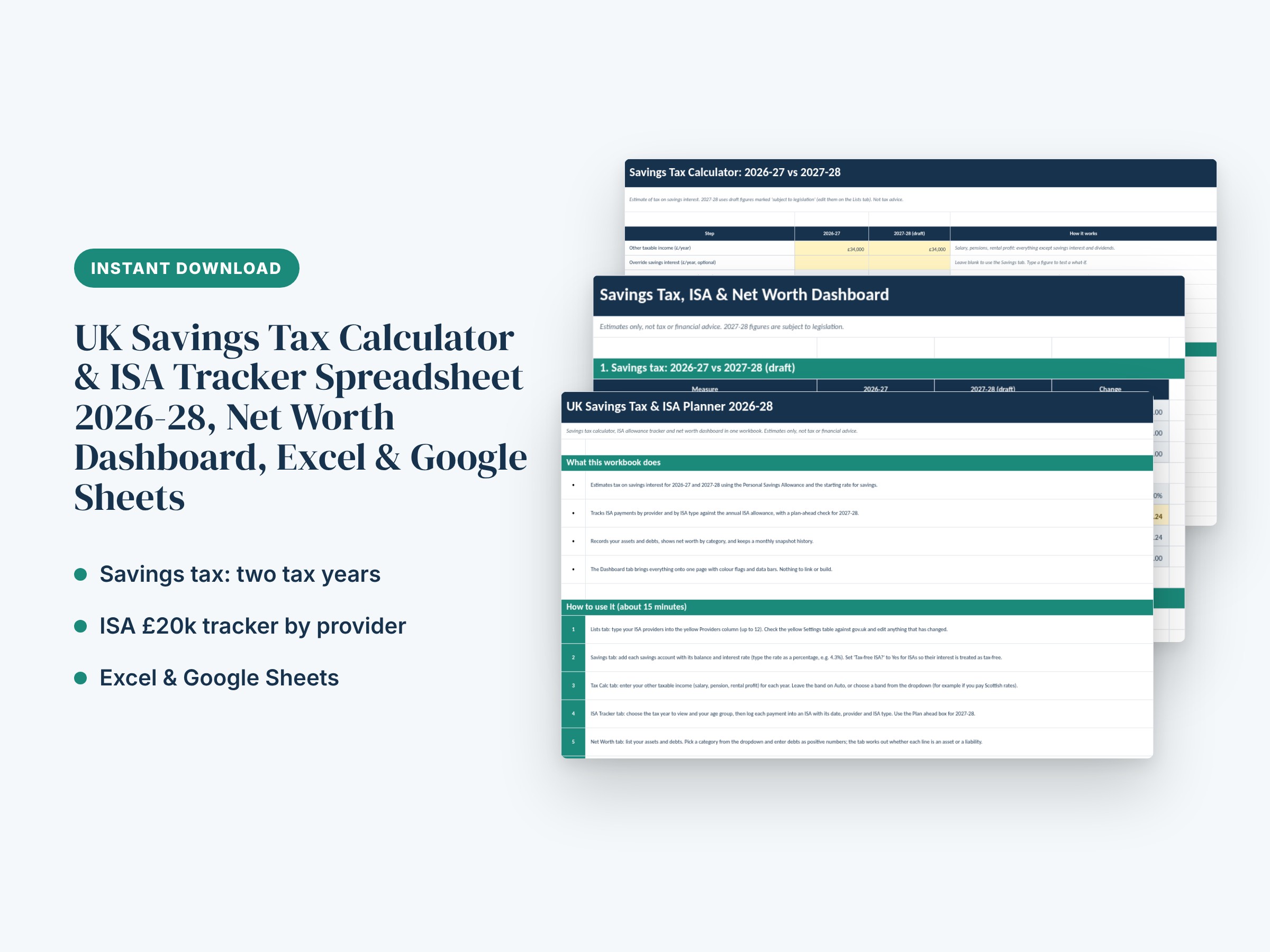
A spreadsheet is a good way to bring these steps together. Once you have set up the formulas, you only need to update the balances and payments. If you would rather not build everything from scratch, the UK Savings Tax Calculator and ISA Tracker Spreadsheet is a ready-made planner for spreadsheet apps. It covers 2026-27 and 2027-28 with a savings tax calculator, an ISA tracker by provider and a net worth dashboard.
This article is general information only and is not financial or tax advice. Rules change, so check GOV.UK or speak to a qualified adviser before making decisions about your money.
Get organised this tax year
Start with your list of accounts today, then add your ISA payments and estimated interest. If you want a head start, see the savings tax and ISA tracker spreadsheet on Oplexa Digital and set up your planner in an afternoon.
Save time: UK Savings Tax Calculator & ISA Tracker Spreadsheet 2026-28, Net Worth Dashboard, Excel & Google Sheets is ready to download and use today.
Stay in the loop.
New templates and member-only offers, now and then. No spam. Unsubscribe in one click.